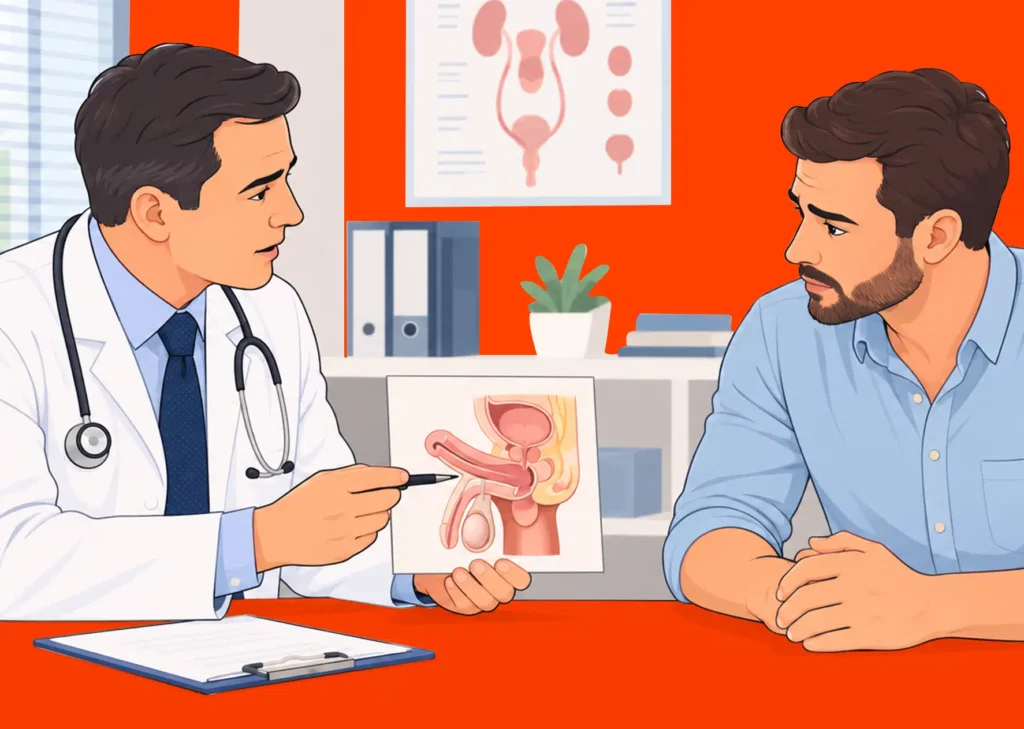
Most of us have heard a joke about an erection that just won’t quit. The real thing isn’t funny. Doctors call it priapism, and it means an erection that lasts far longer than it should, usually past four hours, with no sexual interest or after the interest is gone.
Here’s the reassuring part. It’s treatable, and men who get help early usually do very well. So let’s walk through what’s really going on, what sets it off, and when it’s time to pick up the phone.
Many men put off getting help because the whole subject feels awkward. That delay is the real risk, not the condition itself. A little knowledge up front can save you a lot of worry later, and it might help you support a friend or partner who’s dealing with it.
Table of Contents
TogglePriapism Symptoms and Causes
The main sign is an erection that won’t settle. Other things you might notice:
- A hard shaft with a softer tip
- Pain or throbbing that keeps building
- An erection that started without any arousal
- A shaft that’s only partly firm, in the painless kind
The name comes from Priapus, the Greek god of fertility. Nothing about the condition is mythical, though. It happens when blood gets trapped in the penis, or when too much blood keeps flowing in. Which of those two is happening decides every step that follows.
Types of Priapism
Doctors sort it into three groups.
- Ischemic, or low flow: blood is stuck and can’t drain. It’s the most common kind, it hurts, and it needs urgent care.
- Nonischemic, or high flow: too much blood flows in, often after an injury. It’s usually painless and rarely an emergency, but it still needs a checkup.
- Stuttering: painful erections that come and go, often lasting under four hours each, mostly at night. Some can turn into the low flow kind.
Here’s something people rarely hear. A hard knock to the groin, like slipping onto a bike frame, can trigger the high flow type days or even weeks later. By then most men have forgotten the fall.
What Causes Prolonged Erections?
There’s no single trigger. These are the usual suspects:
- Injection treatments placed straight into the penis, the most common drug cause
- Some antidepressants, such as trazodone, along with certain antipsychotics and blood thinners
- Alcohol, cocaine, and other recreational drugs
- Spinal cord or pelvic injuries
- Rarely, some cancers or venomous bites
And sometimes, honestly, nobody finds a cause. That’s more common than you’d think, and it doesn’t mean you did anything wrong.
Blood Disorders and Prolonged Erections
Blood plays a bigger role here than most people realize. Sickle cell disease is the best known link. In several studies, more than a third of men with it reported at least one episode.
Here’s why. During sleep, erections happen several times a night, and oxygen levels in the tissue dip. Low oxygen makes sickle shaped cells clump together and block the drain. That’s why episodes so often begin at night or in the early morning.
Leukemia, thalassemia, and clotting problems can also play a part. If you live with one of these, ask your doctor about priapism before it happens. Having a plan ready makes a stressful night much easier.
How Is Priapism Diagnosed?
It’s quick, and most of it happens at the bedside. The doctor will ask when it began, how it feels, which medicines you take, and whether you’ve had an injury or a blood condition.
Next, a tiny blood sample is drawn from the penis with a thin needle. Dark, low oxygen blood points to the trapped kind. Bright red blood points to the high flow kind. A color Doppler ultrasound can then show where blood is moving, and blood tests may check for sickle cell or other conditions.
Priapism Treatment Options
What your doctor does depends on the type.
- Trapped blood: the area is numbed, the blood is drained with a needle, and the tissue is rinsed with saline. If needed, a medicine called phenylephrine is injected to help the erection settle.
- Surgery: a small shunt creates a new drainage path. It’s saved for the rare cases where the first steps don’t work.
- High flow: usually watched first, since it can settle by itself. A simple procedure can close the leaking vessel if it doesn’t.
- Stuttering: a specialist can build a prevention plan, which may include hormone therapy.
Ice packs, cold showers, and exercise are popular ideas. None of them is proven to fix trapped blood, so don’t spend precious hours on them.
When to Seek Medical Help for a Prolonged Erection
Head to an emergency room if an erection lasts longer than four hours, or if it becomes painful sooner. Don’t wait for morning, and don’t let embarrassment slow you down. ER teams see this regularly, and they care about your health, not your blushing.
On the way, note the time it started and every medicine you’ve taken. If you used an injection, call your clinic too. A painless, partly firm erection after an injury still deserves a call to your doctor within a day or two.
While you wait for care, don’t take another dose of any ED medicine, and skip alcohol. Stay calm, since stress can make things feel worse. Bring your medicine list or the packaging if you can.
Three Things Most People Don’t Know
- Pain can ease after many hours. That isn’t always good news, because tired tissue can hurt less even when it needs help.
- Children can get it too, especially boys with sickle cell disease. Parents should know the four hour rule as well.
- One episode is a clue. A follow up visit helps your doctor look for a cause and lower the chance of a repeat.
Complications of Untreated Priapism
Trapped blood loses oxygen. Over hours, the tissue inside the penis starts to struggle, and the chance of scar tissue grows with every extra hour. Scarring can lead to lasting erection trouble, a shorter penis, or, very rarely, tissue loss.
Please don’t read that as a reason to panic. It’s a reason to act. Men treated within a few hours often recover normal function, and that’s exactly why the four hour rule exists.
A Quick Word on ED Medicines
If you use ED medicines, you might wonder about the link. Avanafil, one of the faster acting options, and like others in its group, comes with the same advice: get help for any erection lasting more than four hours. Problems from these pills are uncommon, and most men take them without trouble.
A few habits keep things safe:
- Take only the dose your doctor prescribed
- Skip recreational drugs and heavy drinking
- Tell your doctor about every medicine you take, especially antidepressants and blood thinners
- Know your plan before you need it
Frequently Asked Questions
1. Is priapism an emergency?
Yes, when it’s the painful, low flow kind. An erection lasting over four hours needs emergency care to protect tissue and future erections. Painless high flow cases are usually less urgent.
2. Can ED medicines cause priapism?
It’s uncommon. Problems linked to ED pills are rare, but any erection lasting more than four hours needs urgent care, whichever medicine you took.
3. Will a prolonged erection go away on its own?
The high flow type sometimes does. Trapped blood usually doesn’t, and waiting raises the risk of lasting damage, so seek care instead of hoping it passes.
4. Can it start while you're asleep?
Yes. It often begins during sleep, because nighttime erections lower oxygen in penile tissue, especially in men with sickle cell disease.
5. Can it affect your erections later?
It can if treatment is delayed. Quick care lets most men keep normal erections, while long delays raise the chance of scarring and erectile problems.