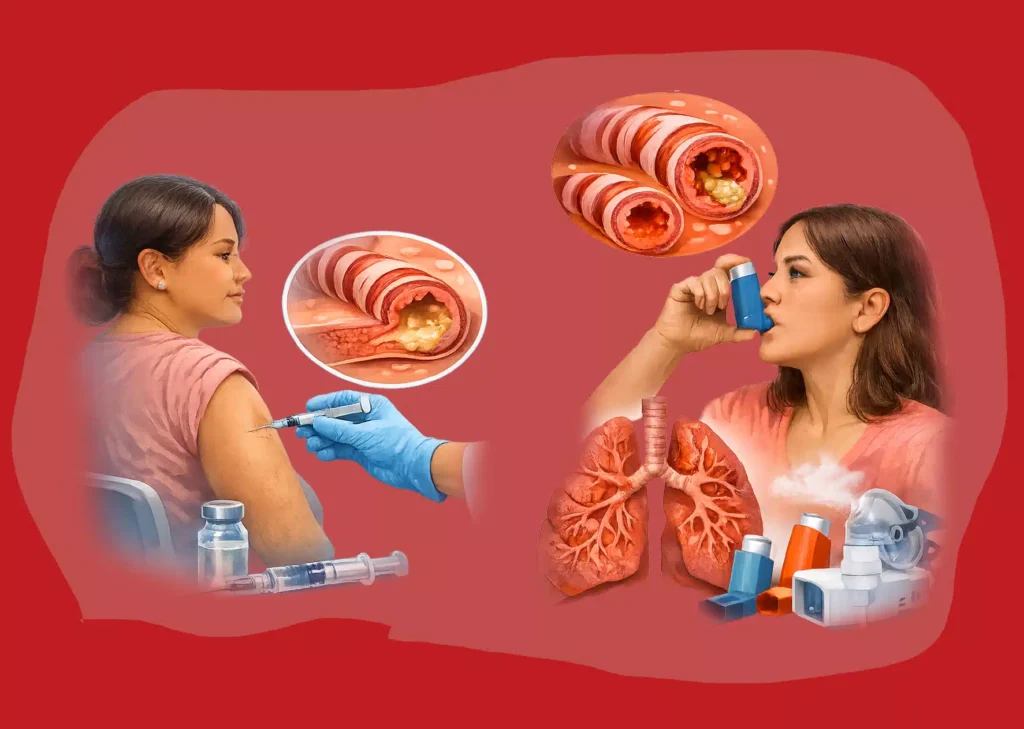
Let’s have an honest conversation.
If you or someone close to you lives with severe asthma, you already know it’s not just “breathing trouble.” It’s the unpredictability. The sudden flare-ups. The persistent worry about triggers. Difficult to sleep. And somewhere along the journey, most people start asking the same question:
Should I continue with inhalers, or is it time to consider biologics?
That’s where the debate around Biologic vs inhaler treatment really begins.
Today, I want to walk you through this topic in a simple, human way. No medical jargon overload. Just clarity.
Table of Contents
ToggleFirst, Let’s Understand Severe Asthma
Severe asthma isn’t the occasional wheeze that improves with a rescue inhaler. It’s the type that persists despite high-dose inhalers. It’s when symptoms continue even though you’re “doing everything right.”
You may already be using:
- A daily maintenance inhaler
- A rescue inhaler
- Oral steroids during flare-ups
Yet the attacks still happen.
This is where comparing Biologic vs inhaler treatment becomes important.
What Is Inhaler Treatment?
Inhalers have been the backbone of asthma care for decades.
Most people with severe asthma use combination inhalers containing:
- Inhaled corticosteroids (ICS)
- Long-acting beta-agonists (LABA)
These reduce inflammation and relax airway muscles.
Inhalers are convenient. Portable. Familiar. For many, they work well.
But in some severe cases, even maximum inhaler therapy isn’t enough.
And that’s when the conversation shifts to Biologic vs inhaler treatment in a more serious way.
What Are Biologics?
Biologics are a newer form of targeted therapy. Instead of broadly reducing inflammation like inhalers, biologics work on specific immune system pathways responsible for severe asthma.
These are typically given as injections either at a clinic or sometimes at home.
They fall under Biologics for severe asthma treatment, especially for patients whose asthma is driven by allergic or eosinophilic inflammation.
In simple terms?
Biologics don’t just calm the lungs. They calm the specific immune signals causing the storm.
Now the question becomes, how do they compare in Biologic vs inhaler treatment?
How Inhalers Work vs How Biologics Work
Let’s simplify it.
Inhalers
- Work locally in the lungs
- Reduce general inflammation
- Relax the airway muscles
- Need daily consistent use
Biologics
- Work through the immune system
- Target specific inflammatory proteins
- Reduce severe flare-ups significantly
- Given every few weeks
So when comparing Biologic vs inhaler treatment, it’s not about which is “better.” It’s about which is appropriate.
When Inhalers Are Enough
Many people manage severe asthma with:
- High-dose ICS-LABA inhalers
- Add-on inhaled therapies
- Occasional oral steroids
If flare-ups are controlled and hospital visits are rare, inhalers may remain the best option.
In the discussion of Biologic vs inhaler treatment, inhalers remain the first-line foundation.
They are effective. Affordable. Proven.
When Biologics Enter the Picture
Now let’s talk about the turning point.
If you experience:
- Frequent asthma attacks despite high-dose inhalers
- Repeated need for oral steroids
- Emergency room visits
- Poor lung function
- High eosinophil counts
Your doctor may discuss Severe asthma biologic therapy.
This is often when patients begin seriously weighing Biologic vs inhaler treatment options.
Injectable Asthma Treatment vs Inhaler: What’s the Real Difference?
When comparing Injectable asthma treatment vs inhaler, the difference isn’t just in form, it’s in depth of action.
Inhalers control symptoms.
Biologics modify the disease pathway.
That’s powerful.
In many studies, biologics have shown:
- Reduced severe exacerbations
- Fewer hospitalizations
- Reduced steroid dependence
- Improved quality of life
- But they are not magic cures.
- And they are not for everyone.
That’s why the Biologic vs inhaler treatment decision must be personalized.
Are Biologics Replacing Inhalers?
Short answer? No.
Even patients on biologics usually continue using maintenance inhalers.
This isn’t an either-or battle.
The Biologic vs inhaler treatment conversation is often about add-on therapy, not replacement.
Biologics are considered one of the more Advanced asthma treatment options for people whose asthma remains uncontrolled.
Think of inhalers as the foundation.
Biologics as reinforcement.
Cost and Accessibility
Let’s talk practically.
For most people, inhalers are the more familiar and affordable option. They’ve been around for decades, and you can usually find them easily at pharmacies. Many patients already have a routine built around them, carrying one in a bag, keeping one by the bedside, maybe even one at work.
Biologics, on the other hand, are a different story. These treatments are newer and significantly more expensive. In many cases, doctors can’t simply prescribe them and send you home with a prescription. Insurance approvals are often required, and there are usually specific medical criteria that need to be met before a patient qualifies.
Cost is a practical consideration when comparing Biologic vs inhaler treatment
Access is important.
Side Effects Comparison
Inhalers may cause:
- Slight tremors
- Hoarseness
- Oral thrush
- Increased heart rate
Biologics may cause:
- Slight headaches
- Injection site reactions
- Uncommon allergic reactions
Biologics are generally well tolerated, but careful observation is required.
Again, in Biologic vs inhaler treatment, safety profiles differ but are manageable under medical supervision.
When to Switch to Biologics Asthma Treatment
One of the most common questions patients ask is about when to switch to biologics asthma therapy.
Here’s a simple guideline:
Consider discussing biologics if:
- You’re on maximum inhaler therapy
- You need oral steroids multiple times a year
- Asthma limits daily life
- You’ve had severe attacks requiring hospitalization
Switching doesn’t mean failure. It means escalation to better control.
This stage of the Biologic vs inhaler treatment journey is about reclaiming stability.
Lifestyle Impact
Let’s get real.
Living with uncontrolled severe asthma is exhausting.
Missing work. Avoiding exercise. Fear of triggers. Carrying rescue inhalers everywhere.
Many patients who qualify for biologics report feeling like they “got their life back.”
In long-term comparisons of Biologic vs inhaler treatment, quality-of-life improvements often tip the scale for eligible patients.
But again, only when the criteria are met.
Who Should NOT Consider Biologics?
Biologics are typically reserved for:
- Severe asthma
- Specific inflammatory markers
- Poor control despite inhalers
If asthma is mild or moderate and controlled, inhalers remain appropriate.
The Biologic vs inhaler treatment comparison only applies to severe, uncontrolled cases.
Is One Superior?
That’s the wrong question.
The right question is:
Which stage of asthma are you in?
In early or controlled severe asthma, inhalers may be sufficient.
In persistent, steroid-dependent cases, biologics may change the game.
So instead of thinking in extremes, think in progression.
The Biologic vs inhaler treatment conversation is about tailoring therapy.
The Emotional Side of the Decision
Let’s acknowledge something most articles ignore.
Moving to biologics can feel scary.
Injections. Specialist visits. The label “severe.”
But for many, it also feels hopeful.
Better breathing isn’t just physical relief, it’s emotional freedom.
And that’s often the hidden layer in the Biologic vs inhaler treatment decision.
Final Thoughts
Severe asthma management has evolved dramatically.
Inhalers remain the backbone of care.
Biologics represent precision medicine targeted, advanced, and transformative for the right patient.
If your asthma is well controlled, stay consistent with inhalers.
If it isn’t, speak to your pulmonologist about eligibility for biologics.
The goal isn’t choosing sides in Biologic vs inhaler treatment.
The goal is control. Stability. And breathing without fear.
Frequently Asked Questions
1. How do I know if I qualify for biologics?
Doctors evaluate the frequency of attacks, steroid dependence, lung function, and inflammatory markers before recommending Severe asthma biologic therapy.
2. Are biologics better than inhalers for severe asthma?
That’s a question many people ask when they first hear about biologic treatments. The honest answer is that biologics work differently from inhalers. The majority of people still use inhalers as their primary daily treatment, but biologics are typically used when a patient’s asthma is still uncontrolled despite frequent use of high-dose inhalers.
3. If I start taking biologics, can I stop using my inhaler?
In most cases, no. Even when biologics were introduced, doctors usually recommend continuing maintenance inhalers. Think of inhalers as the foundation of asthma management. Biologics may help reduce flare-ups and improve control, but they generally work alongside inhalers rather than taking their place.
4. How long does it take for biologics to work?
It varies from individual to individual. Some patients see improvements in just a few weeks, while full benefits may take several months. Changes may happen slowly as the body responds to the treatment because biologics target certain immune pathways.
5. Are biologics safe for a long time?
Recent studies show that biologics are usually safe as long as they are watched closely. Your expert will look at each risk one at a time.