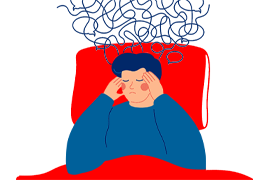
Put yourself into the situation and just think about it. Everything seems fine before sex. You feel attracted to your partner, the mood is right, and then suddenly your mind starts racing. What if I finish too quickly again? Will my partner be disappointed? Can I control it this time? You try to not think about it that much, but you just end up doing that all the way more. The more you focus on lasting longer, the more tense your muscles get, and before you know it, your moment is over.
Most people are just left with embarrassment and frustration after, with no clue what will happen the next time and tons of anxiety.
This is a much more common pattern than we realize. This is why the psychological causes of premature ejaculation (PE) need more attention than we give them. The initial worry can turn into a loop of anticipation and anxiety that can fuel the following interactions and get reinforced due to the failed attempts. Factors like performance anxiety, everyday stress, relationship strains, and other factors can all influence the way in which a man experiences and controls his ejaculation. In fact, a large international PEPA survey of 12,133 men found that men reporting PE were also more likely to report anxiety, depression, and excessive stress than men without PE.
The good news is that understanding what is happening mentally is often the first step toward changing the pattern that’s putting a damper on the mood. This doesn’t mean that PE is just all in your head. It’s just that your brain, emotions, and body are heavily connected and it will just help to know of the psychological causes of premature ejaculation
Table of Contents
ToggleWhat is Premature Ejaculation?
Premature ejaculation (PE) is a common sexual dysfunction that several men experience. PE is when a man ends up ejaculating sooner than he desires. Sure, it can happen here or there. It becomes a genuine problem when it consistently keeps happening and puts a strain on the individual’s relationship with their partner.
PE is broadly categorized into two types. A man can have PE all their life, which is known as lifelong PE. Then there’s acquired PE, which a person can develop at any point in their life. The psychological causes of premature ejaculation mostly end up contributing to the acquired one. PE is also more common than many men assume. A PEPA survey done on men from the United States, Germany, and Italy found that around 22.7% of men self-reported that they have or have had to deal with PE.
As we mentioned, you should look into your health when the problem happens repeatedly and creates significant distress in your relationship and for yourself. Looking at psychological causes of premature ejaculation can be particularly useful when ejaculation changes during periods of anxiety, emotional strain, or relationship difficulty.
How the Mind Influences Ejaculation
The process of ejaculation is one that involves a kind of complex communication between your brain, spinal nervous system, genital stimulation, neurotransmitters, and your emotional state. Your mood and psychological state can interfere with this system by altering the muscle tension, attention, and arousal sensations.
Stress is one of the most significant psychological causes of premature ejaculation. How stress affects ejaculation control isn’t just abstract psychology. When someone gets anxious during sex, their body enters a heightened state of alertness. Their heart rate may increase, their attention may just drift towards their performance, and the normal sexual stimulations may just end up feeling more intense to the person. The anxious tension can tighten pelvic floor muscles without you even noticing. So it’s not purely “in your head” even though it starts there.
A small clinical study examining different PE subtypes found that acquired PE was highly associated with performance anxiety. While the participant amount was less, it still shows that psychological states are important to consider. This is honestly one of the more underrated psychological causes of premature ejaculation because it sits right at the border of mind and body.
Effect of Stress and Anxiety
Just now we looked at how the bodily mechanisms can make an individual ejaculate faster. Well, it does start at stress before your body starts reacting. Stress is another significant factor among the psychological causes of premature ejaculation we will take a look at today.
Stuff like work stress, money stress, and family stuff never quite neatly stay outside the bedroom. These factors can still affect an individual’s sexual functioning even if they don’t necessarily have anything to with sex and are not related. Stress and premature ejaculation are connected in a way that many men don’t realize.
But the body doesn’t really separate stress from stress. Cortisol doesn’t know if you’re worried about a deadline or worried about sex. It just floods the system either way, and that has physical consequences on top of the mental ones.
Being stressed all the time can make someone distracted and increase their physiological arousal and at the same time reduce their sense of relaxation. Even during intercourse, a stressed person can experience difficulty focusing on the pleasurable sensations.
Can anxiety cause premature ejaculation? Yes, absolutely, actually. Anxiety can start an anxiety feedback loop. An individual may constantly worry about ejaculating too soon, and that worry can increase their physiological arousal and make them more sensitive. They may monitor themselves too much and notice every little thing about themselves, which might put more pressure on them. It’s a constant feedback loop.
Relationship Problems and PE
Relationship problems and PE go together more than people expect. Arguments, distance, feeling judged, and not talking about sex openly can all add pressure. And pressure in a relationship tends to show up in the bedroom whether anyone wants it to or not.
Sometimes it’s not even active conflict. Just quietly feeling like you’re being evaluated every time can be enough. That evaluation feeling is basically the same pressure-to-perform thing wearing a different outfit.
There’s also the guilt spiral. A man notices PE happening, feels bad about it, gets more anxious next time, and the cycle just keeps going. Some men describe this as the moment they realized the psychological causes of premature ejaculation weren’t going away on their own.
Early Sexual Conditioning
There’s also this thing nobody really talks about, early sexual conditioning. Guys who grew up rushing through masturbation because they were worried about getting caught sometimes carry that “hurry up” pattern into adult sex without even realizing it. It’s not conscious. It’s just how the body learned to respond years ago, and it doesn’t automatically update itself just because the situation changed.
It doesn’t apply to everyone, obviously. Some men never had that experience at all and still deal with the same timing issues for completely different reasons. That’s the frustrating part of all this, two guys can have the exact same symptom and completely different backstories behind it.
Age plays a role too sometimes, though not in a straightforward way. Younger men often report it more, possibly tied to less experience and more nerves generally. Older men sometimes notice it creeping back in during periods of higher stress or after a long dry spell, which loops right back to the anxiety piece again.
How to Break the Psychological Cycle of PE
Going for psychosexual therapy or CBT (cognitive behavioral therapy) can help an individual identify their catastrophic line of thinking and help them deal with the stress and anxiety of performing or letting their partner down. Replacing thoughts like “my partner will hate me” or “I will always finish too quickly” with productive and less negative thoughts can always help break the toxic cycle off. Along with this, setting realistic expectations for yourself is always advisable.
Along with that, employing behavioral techniques like the start-stop technique, sensate-focus exercises, slower pacing, or pelvic floor exercises are always things that can help you physiologically.
Lastly, and something that is honestly the most important, is communicating with your partner. A supportive partner and productive conversations can make you get past any hurdle. They can make any sexual experience feel less like an examination and more like a shared experience to cherish.
Medications for PE
Now, psychological causes don’t mean medication is useless, sometimes it’s part of breaking the cycle while the mental side gets worked on separately. Dapoxetine-based options are commonly used here because they’re specifically designed to help delay ejaculation rather than just treat erectile issues.
Poxet 90 mg is one version people look into, generally used as a short-acting option taken before sexual activity. Dapocare 60 mg is another dapoxetine formulation some men prefer, often depending on dosage tolerance and how their bodies respond. And then there’s Priligy 30 mg, probably the more recognizable brand name for a lot of people and usually the starting point for those trying dapoxetine for the first time.
None of these fix the psychological causes of premature ejaculation on their own, to be clear. They buy time, basically. Give a bit more control while the actual root cause, anxiety, stress, relationship tension, or whatever it is, gets addressed properly, maybe with therapy or just time and communication.
Final Thoughts
Occasionally experiencing issues with ejaculation is one thing and doesn’t require too much worrying. You should only start looking for medical attention when it becomes a regular thing and starts distressing you and your partner in a genuine manner.
A healthcare provider will look at your pattern and help you identify whether it fits PE or not. There’s no single fix, though. It’s rarely one clean cause with one clean solution, which is honestly the main thing to take away if you’re trying to make sense of the psychological causes of premature ejaculation in your own situation.
FAQs
1. Can stress alone cause premature ejaculation?
Yes, ongoing stress can absolutely contribute to it, even without a diagnosed anxiety disorder.
2. Is premature ejaculation always psychological?
Not always, sometimes physical factors play a role too, but psychological ones are extremely common.
3. Does dapoxetine treat the root cause?
No, it helps manage timing short-term while the underlying issue gets addressed separately.
4. Can therapy actually help with this?
Yes, especially therapy focused on anxiety and performance-related thought patterns.
5. Is this going to sort itself out?
Sometimes, especially if it’s tied to a one-off stressful period, but ongoing cases usually need more direct attention.