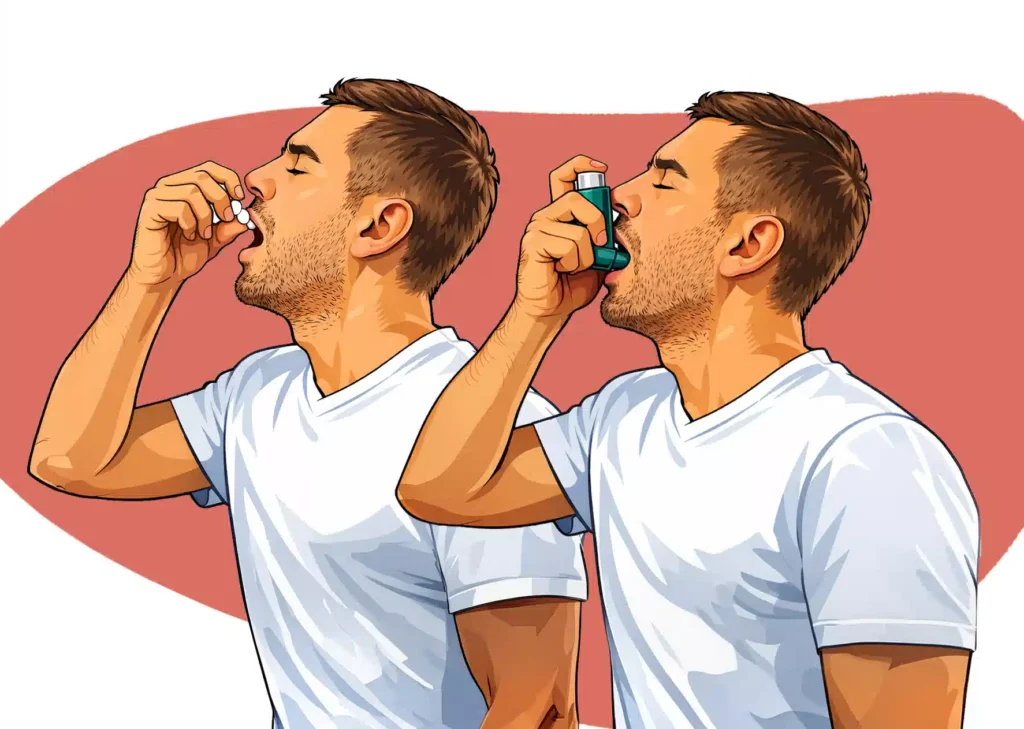
If you or someone in your family has asthma or COPD, you’ve probably heard this question more than once:
“Should I take tablets, or is an inhaler better?”
It’s a fair question. Swallowing a pill feels simple. Inhalers can seem complicated at first. But when it comes to breathing problems, the choice between inhaler therapy vs oral medication can make a big difference in how well your symptoms are controlled.
Let’s sit down and talk about this the way we would in a clinic, clearly, honestly, and without medical jargon overload.
Table of Contents
ToggleFirst, Why Does the Delivery Method Even Matter?
Respiratory diseases like asthma and COPD affect your airways directly. The problem is inside your lungs, inflammation, tightening of muscles, and excess mucus.
So here’s the big idea behind inhaler therapy vs oral medication:
- One option sends medicine straight to the lungs.
- The other sends medicine through your whole body first.
That difference alone changes everything.
What Is Inhaler Therapy?
Inhalers deliver medication directly into your airways when you breathe in. The drug goes exactly where the inflammation or constriction is happening.
This is what doctors call lung-targeted therapy, meaning the medicine works right at the source of the problem.
When we compare inhaler therapy vs oral medication, inhalers have one major advantage: precision.
Instead of traveling through your stomach, bloodstream, and then finally reaching your lungs, the medication goes straight into your breathing passages within seconds.
Inhaled Treatment Benefits
Let’s talk honestly about the inhaled treatment benefits people notice:
- Faster symptom relief
- Lower overall drug dose
- Fewer whole-body side effects
- Better long-term control for chronic conditions
That’s why inhalers are the first-line treatment for asthma and COPD worldwide.
What Are Oral Respiratory Drugs?
Oral respiratory drugs include tablets or syrups that reduce inflammation, relax airway muscles, or control allergic responses.
These medications travel through:
- Your digestive system
- Your bloodstream
- Then, finally, your lungs
Because they circulate throughout the body, they may affect other organs too.
When discussing inhaler therapy vs oral medication, this “whole-body exposure” is where side effects often enter the conversation.
Asthma Tablets vs Inhalers: What’s the Real Difference?
Let’s talk specifically about asthma tablets vs inhalers.
In asthma, the inflammation in the airways is only in the lungs. Inhaled corticosteroids go right to the source of the inflammation.
Asthma tablets (like oral steroids or leukotriene modifiers) are usually prescribed:
- During severe flare-ups
- When asthma isn’t controlled with inhalers
- For specific allergic asthma patterns
But long-term oral steroid use can cause:
- Weight gain
- Mood changes
- High blood sugar
- Bone thinning
That’s why, in most cases, doctors prefer inhalers for daily control when weighing inhaler therapy vs oral medication.
COPD Medication Comparison: Which Approach Wins?
When it comes to COPD medication comparison, inhalers again dominate routine treatment.
Over time, COPD causes the airways to gradually narrow and become clogged with mucus. The mainstay of treatment consists of inhaled steroids and long-acting bronchodilators.
Oral medications may be added in very bad cases, but they are not the first choice very often.
In the discussion of inhaler therapy vs oral medication, COPD management strongly favors inhalers for maintenance therapy.
Why Inhalers Often Make More Sense
Let’s break this down in practical terms.
Imagine you have a small fire in one room of your house.
Would you flood the entire house with water or spray directly on the fire?
That’s essentially the difference between inhaler therapy vs oral medication.
Inhalers:
- Act locally
- Use smaller doses
- Reduce systemic exposure
Oral medications:
- Travel everywhere
- Require higher doses
- May increase side-effect risks
But Are Tablets Ever Better?
Yes, and this is important.
There are situations where oral medication is helpful:
- Severe asthma attacks requiring short-term oral steroids
- Patients who struggle with inhaler technique
- Certain inflammatory patterns
- Specific allergic triggers
So the conversation about inhaler therapy vs oral medication isn’t about “good vs bad.”
It’s about “what’s appropriate for your condition right now?”
The Side Effect Conversation
This is where many patients hesitate.
Inhaled medications may cause:
- Mild throat irritation
- Hoarseness
- Oral thrush (preventable by rinsing the mouth)
Oral medications may cause:
- Stomach upset
- Sleep changes
- Weight changes
- Blood pressure fluctuations
When comparing inhaler therapy vs oral medication, side-effect profiles often tilt the balance toward inhalers for long-term daily management.
Speed of Relief Matters
In emergency breathing situations, speed matters.
Rescue inhalers open airways within minutes. Tablets cannot work that quickly because they must be digested first.
This alone changes how we view inhaler therapy vs oral medication in acute episodes.
Inhaled bronchodilators work much faster than pills if someone is wheezing and having trouble breathing.
Long-Term Disease Control
For chronic respiratory diseases, consistency is key.
Inhaled maintenance therapy helps:
- Prevent flare-ups
- Reduce hospital visits
- Improve lung function stability
- Lower long-term complications
When doctors evaluate inhaler therapy vs oral medication, they usually prioritize long-term safety and control, not just convenience.
The Technique Factor
Here’s something people don’t talk about enough.
Inhalers only work well if used correctly.
Poor inhaler technique can reduce effectiveness by up to 50%.
So sometimes when patients feel inhalers “don’t work,” it’s not the medication, it’s the method.
In the real-world debate of inhaler therapy vs oral medication, ease of use sometimes influences patient preference more than medical science does.
That’s why proper inhaler training is crucial.
Cost and Accessibility
Cost can alter decisions based on where you live and how easy it is to get medical care.
Oral drugs may be less expensive or easier to find in some places.
When asthma or COPD isn’t well controlled, it can land people in the hospital, costing way more than simply using preventive inhalers regularly.
So when considering inhaler therapy vs oral medication, long-term health economics matter too.
What Do Most Guidelines Recommend?
Globally, respiratory treatment guidelines consistently recommend inhalers as first-line therapy for:
- Persistent asthma
- COPD maintenance
- Exercise-induced bronchospasm
Oral medications are usually reserved for:
- Short courses
- Add-on therapy
- Specific phenotypes
The scientific consensus in the discussion of inhaler therapy vs oral medication strongly favors inhaled therapy for routine control.
Emotional Side of the Decision
Let’s be honest.
Some people feel embarrassed using inhalers in public.
Some feel “sicker” when prescribed an inhaler.
Some prefer tablets because they feel simpler.
But breathing well isn’t about appearances.
It’s about keeping your lungs safe for a long time.
When you really understand inhaler therapy vs oral medication, the goal becomes clearer: keep your lungs working well, cut down on flare-ups, and keep your quality of life high.
So… Which One Should You Choose?
Here’s the honest answer:
For most people dealing with asthma or COPD, inhalers usually end up being the go-to treatment. And it makes sense they send the medicine straight into the lungs, exactly where the problem is. They’re built for daily control, helping you stay steady instead of constantly reacting to symptoms.
That doesn’t mean tablets don’t matter. They absolutely do. But they’re often brought in when things flare up or when the body needs a little extra support. They frequently function in conjunction with inhalers for a brief time rather than taking their place entirely.
The real decision in inhaler therapy vs oral medication isn’t one-size-fits-all, based on:
- The severity of the disease
- The frequency of flare-ups
- Age
- Additional medical conditions
- Lifestyle
- Ability to use an inhaler properly
Final Thoughts
If we step back and look at the big picture, the debate around inhaler therapy vs oral medication isn’t really a competition.
It’s about targeted care.
Inhalers send medicine just where it needs to go.
Oral medications support in specific situations.
For most asthma and COPD patients, inhalers form the foundation of treatment, and for good reason.
Your lungs deserve precision, not guesswork.
FAQs
1. Can children use inhalers safely?
Yes, and they often do very well with them. In fact, inhalers are commonly prescribed for children with asthma because they deliver small, targeted doses. Using a spacer device makes them even easier and more effective.
2. If I feel fine, can I stop my inhaler?
Feeling fine usually means the treatment is working. Stopping suddenly can allow inflammation to quietly build up again, even if you don’t notice symptoms right away. Always speak with your doctor before making changes.
3. Do inhalers eventually stop functioning?
Not very common at all. If your inhaler doesn’t seem to be working as well as it used to, it’s usually because you’re not using it correctly, you’re missing doses, or your condition is getting worse because your body hasn’t “become immune” to it. A quick discussion about your technique with your doctor can make a big difference.
4. Can long-term use of steroid tablets be safe?
Although they can be quite beneficial, they are typically not intended for daily, long-term use unless absolutely necessary. They may begin to affect other parts of the body after being used continuously for weeks or months. Therefore, rather than using them as a long-term solution, most doctors try to use them as a temporary rescue.
5. What if I'm afraid of becoming dependent on an inhaler?
Using an inhaler every day is not an addiction; it’s just taking care of yourself. Inhalers help keep your airways stable, just like someone with high blood pressure takes medicine every day. They are there to stop problems, not make people dependent on them.